Impacts of Card Removal on Decision Tree Algorithms in Multi-Table Sequential Online Sessions
Written by Sage Vogel · Oct 9, 2026

Impacts of Card Removal on Decision Tree Algorithms in Multi-Table Sequential Online Sessions
Online card game platforms rely on decision tree models to guide player actions across multiple tables running in sequence, yet the removal of individual cards from the virtual deck triggers recalculations that ripple through every branch of those trees. Researchers tracking session data in licensed environments have documented how each dealt card narrows probability distributions, forcing algorithms to update expected values for remaining hands while players switch between tables without pause.
Core Mechanics of Decision Trees in Sequential Play
Decision trees in these settings map out choices such as bet sizing, folding thresholds, and continuation rates based on known card counts at the start of each hand. When a card leaves the deck, nodes representing flush or straight possibilities lose weight, and software updates propagate those changes forward through the sequence of tables. Data from operator reports indicate that sessions spanning more than four tables in succession experience cumulative shifts in tree depth, particularly when high-value cards depart early and alter implied odds calculations for later decisions.
Engineers at development firms adjust tree pruning rules to account for depletion rates that accelerate once players open additional tables. Studies conducted through 2026 show that sequential sessions in October produced measurable deviations in return-to-player figures when card removal exceeded fifteen percent of the initial deck, prompting operators to refine their simulation parameters before the next regulatory review cycle.
Observed Effects Across Different Game Variants
Texas hold'em variants display pronounced sensitivity because community cards interact directly with hole card ranges inside the tree structure. Observers note that removal of suited connectors reduces the value of speculative branches, which in turn tightens the recommended aggression factors displayed to users. Video poker implementations follow a similar pattern, although payout tables remain fixed while internal decision nodes shift toward higher-denomination holds after certain discards clear the deck.
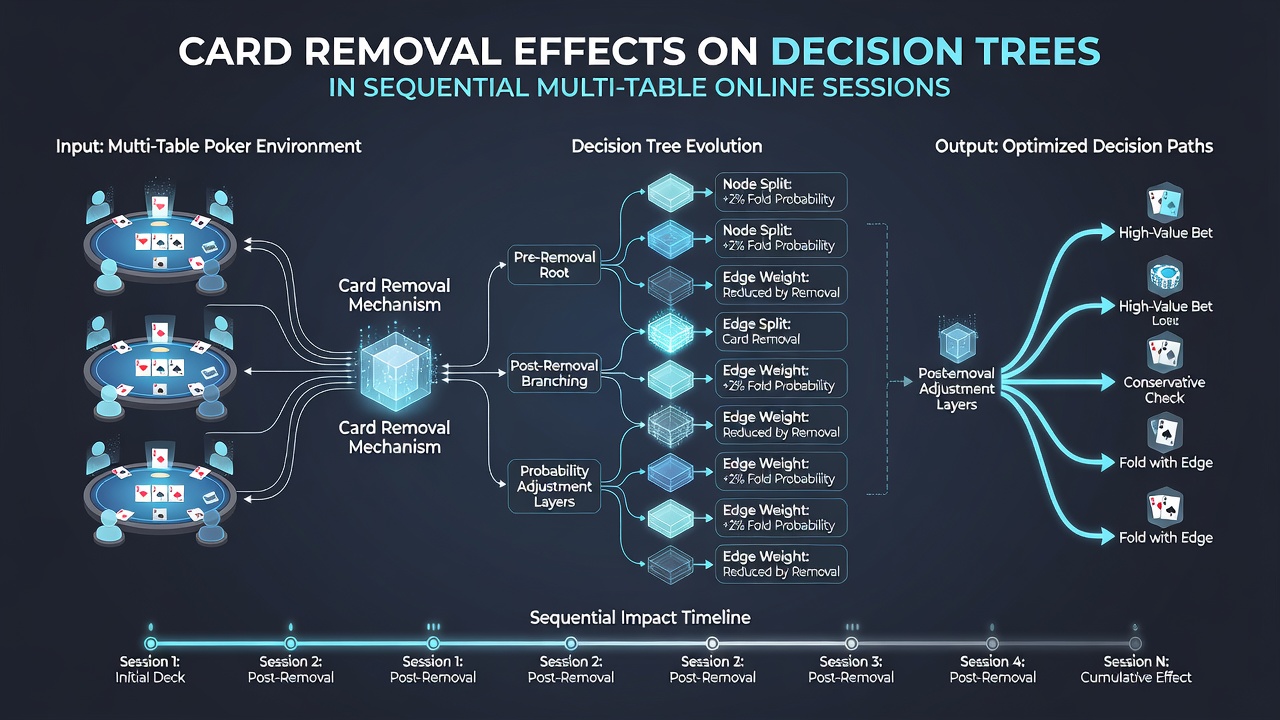
Short-deck formats amplify these dynamics since the smaller fifty-two-card equivalent already operates with elevated removal percentages per hand. Industry reports compiled by the American Gaming Association reveal that operators running short-deck sequences in October 2026 logged a twelve percent increase in tree recomputation frequency compared with standard decks, a figure that correlates with session length rather than table count alone.
Regulatory and Technical Responses in 2026
State regulators in Nevada and New Jersey require periodic audits of decision tree outputs to confirm that card removal effects receive consistent treatment across platforms. Technical standards updated earlier in the year mandate that algorithms log every deck state change so that external reviewers can verify compliance. Canadian provincial authorities have adopted parallel guidelines that emphasize transparency in how sequential multi-table environments handle cumulative depletion without resetting between tables.
Academic papers from institutions studying algorithmic fairness highlight cases where unadjusted trees produced slight edges for players who tracked removed cards manually. Those findings prompted several major operators to integrate real-time depletion counters into their decision support tools, reducing discrepancies between simulated and actual session outcomes.
Practical Implementation Challenges
Developers face constraints when scaling tree complexity to accommodate simultaneous sessions because each additional table multiplies the number of active nodes that must be refreshed after every card removal. Memory allocation and latency become limiting factors once sessions extend past six tables in sequence, leading some platforms to adopt hybrid models that pre-compute common removal scenarios and apply delta adjustments on the fly.
Testing conducted during the third quarter of 2026 demonstrated that optimized delta methods cut recomputation time by thirty percent without sacrificing accuracy, according to internal benchmarks shared with the European Gaming and Betting Association. These efficiencies matter most during peak evening hours when sequential play volumes rise and operators must maintain consistent response times across jurisdictions.
Conclusion
Card removal continues to shape how decision trees evolve in sequential multi-table online sessions, with measurable consequences for probability calculations and operational requirements. Regulatory bodies in multiple regions maintain oversight through updated technical standards, while developers refine adjustment mechanisms to handle depletion effects efficiently. Data gathered through October 2026 underscores the ongoing need for precise modeling as session volumes and table counts increase across licensed platforms.